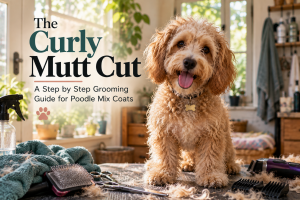
Curly coated mutts are deceptive.
They can look fluffy, soft and perfectly brushable right up until you put your fingers into the coat and discover an entire underground civilization of tangles.
That’s why a good curly mutt cut starts long before the clippers come out.
Poodle mixes can inherit wildly different coats. One dog gets tight curls. Another gets loose fleece. Another gets mostly straight hair with a few curls around the ears just to keep everybody confused.
So this isn’t a guide for making every Poodle mix look the same.
It’s about figuring out what your particular pile of fluff will let you do.
Step 1: Get Your Hands Into the Coat
Before choosing a haircut, feel the coat all the way down to the skin.
Don’t just run your hand over the top.
Part the hair in several places and look underneath.
Check especially:
- Behind the ears
- Under the collar or harness
- Armpits
- Chest
- Belly
- Inside the legs
- Tail
- Around the feet
These are prime real estate for tangles.
Then use a metal comb.
A brush can glide beautifully across the surface while leaving knots underneath. Your comb is less easily impressed.
If it reaches the skin and moves through the coat without getting stuck, you’ve got options.
If it doesn’t, deal with the tangles before deciding how much length you want to keep.
Step 2: Decide Whether You’re Dealing With Tangles or Matting
A few tangles and a tightly matted coat aren’t the same thing.
Small, loose tangles may be manageable with careful brushing and combing.
Dense matting close to the skin is different.
Trying to preserve several inches of badly matted hair can mean repeatedly pulling at the dog’s skin. At some point, saving the haircut stops being worth what you’re asking the dog to tolerate.
That’s when shorter mutt cuts become practical.
Maybe much shorter.
It can be disappointing when you wanted a fluffy teddy bear cut.
The dog, however, did not make a Pinterest board.
Comfort wins.
Step 3: Bathe Before You Start Cutting
For a normal groom on a coat that isn’t severely matted, clean hair generally gives you a better finished cut.
Dirt, oil and debris affect how the coat behaves.
Use a dog appropriate shampoo and rinse thoroughly.
Really thoroughly.
Curly coats can hold onto product, so keep rinsing after you think you’re finished.
Conditioner can help when appropriate for the coat and product you’re using, but don’t assume more product automatically means softer hair.
You want clean, manageable coat, not a dog marinating in conditioner.
Step 4: Dry and Straighten the Coat
This step makes a huge difference.
If you clip curly hair while it’s still curled unevenly, the finished length can look uneven too.
Professional groomers use drying techniques to straighten and fluff the coat before finishing the haircut.
At home, your goal is simply to get the coat completely dry and as evenly prepared as you safely can.
Keep heat at a safe temperature.
Don’t blast air directly into the eyes, ears or other sensitive areas.
And pay attention to your dog.
If the dryer is terrifying, don’t turn the grooming session into a hostage situation for the sake of a perfectly fluffy finish.
Drying equipment can be introduced gradually.
Step 5: Comb Again
Yes.
Again.
Once the coat is clean and dry, run your comb through it.
Bathing and drying can reveal tangles you missed earlier.
The coat should be separated and manageable before you start trying to create an even haircut.
This is also when you’ll get a much better idea of how much hair is actually there.
A freshly fluffed curly mutt can suddenly double in apparent size.
Enjoy your temporary sheep.
Step 6: Choose a Realistic Length
Here’s where pet parents get themselves into trouble.
They want the dog fluffy.
There’s nothing wrong with fluffy.
But every extra bit of length becomes coat you’ll need to maintain afterward.
If you don’t brush very often, choose a shorter cut.
If your dog swims, hikes, rolls in the yard or spends weekends trying to become one with a mud puddle, choose accordingly.
If you’re committed to brushing and combing several times a week, you may be able to maintain more coat.
There isn’t a morally superior hair length.
There’s just the length that works for your dog and your routine.
Shorter curly mutt cuts
A shorter body is easier to maintain and can dramatically reduce tangling.
You can still leave personality on the face, ears and tail.
Medium length cuts
These preserve more fluff while remaining manageable for many dogs if they’re brushed consistently.
Longer cuts
Beautiful when maintained.
A nightmare when they’re not.
Know which household you live in.
Step 7: Start With the Body
If you’re learning mutt cuts dog grooming at home, the body is usually a more forgiving place to begin than the face.
Use equipment designed for dog grooming and know what your blade or guard is going to leave behind before putting it on the dog.
Work methodically rather than repeatedly running clippers over random sections.
Pay particular attention around:
- Armpits
- Skin folds
- Tuck up
- Groin
- Nipples
- Legs
- Neck
Dog skin moves.
Loose skin can get caught where you absolutely do not want it caught.
Keep the skin controlled and don’t force equipment through resistance.
If you don’t know how to safely clip an area, leave it alone until you do.
A slightly uneven dog is preferable to an injured one.
Step 8: Blend the Legs
You have choices here.
For a simple cut, the legs can be brought closer to the body length and blended.
For a fluffier look, leave more length on the legs.
That’s one of the classic ways to create cute cuts for mutts without keeping the entire body long.
But remember what we learned in Blog 2.
Fluffy legs are adorable.
Fluffy legs also collect things.
If you leave them longer, comb them regularly from the feet upward and check where the legs meet the body.
Step 9: Shape the Feet
Curly feet can go from teddy bear to bedroom slippers surprisingly fast.
Comb the hair out before trimming so you can see what you’re actually shaping.
The goal is generally a neat foot that works with the leg rather than an abrupt little peg at the bottom.
Be especially cautious around toes and pads.
Dogs move their feet quickly when something tickles, pulls or feels strange.
This is not the place for confident improvisation with scissors.
Step 10: Deal With the Face
And now we arrive at the part everybody cares about.
The face.
A good body haircut with a strange face is still a strange haircut.
Curly coated mixed breeds often have enough facial hair to create several different looks.
You can keep it round and fluffy.
Shorten the muzzle.
Leave fuller cheeks.
Keep longer ears.
Go shorter around the mouth.
Or preserve a slightly scruffier look if that’s what suits the dog.
The eyes should be visible and the mouth area manageable.
Hair that constantly falls into the eyes or collects food and water isn’t doing anybody any favors just because it looked cute for twelve seconds after grooming.
Don’t chase perfect symmetry
Your dog moves.
Their ears sit differently.
Their hair grows differently on each side.
Their skull may not be perfectly symmetrical either.
Step back frequently and look at the whole dog.
If you stare at one cheek for ten minutes, eventually you will convince yourself that it has personally betrayed you.
Step 11: Check the Ears and Tail
These areas can often stay fuller even when the body is shorter.
That’s one reason curly coated dogs offer so many styling options.
But both areas are also prone to tangles.
Comb the ears carefully, including behind them.
Check the entire tail rather than brushing only the fluffy outside.
If you’re leaving either area long, you’re also agreeing to maintain it.
That’s the contract.
The dog will not be helping.
Step 12: Step Back Before You Keep Cutting
This might be the most important grooming step nobody talks about.
Stop.
Put the scissors down.
Let the dog move around.
Look again.
There is a dangerous point during every DIY haircut when a person thinks:
“I’ll just fix this one little piece.”
Forty minutes later the dog has one eyebrow.
Small imperfections disappear when the dog moves.
Don’t destroy a perfectly decent haircut trying to make a living animal geometrically perfect.
What About the Teddy Bear Cut?
People use “teddy bear cut” to describe several different things, which is why a photo is useful.
Generally, people mean a softer, rounded face combined with a fluffy, balanced body.
But the exact result depends on the dog’s coat density, curl, muzzle, ears and overall structure.
Two Poodle mixes can receive the same requested haircut and look completely different afterward.
That’s not necessarily the groomer’s fault.
They’re working with different raw materials.
Ask for the features you actually like.
For example:
“I like the round face.”
“I want the body shorter but the legs fuller.”
“Please keep the ears fluffy.”
“I want the muzzle shorter.”
Those instructions communicate more than simply saying “teddy bear.”
How Often Does a Curly Mutt Need Grooming?
There isn’t one schedule that fits every curly coated dog.
Longer coats generally require more frequent maintenance.
So do coats that mat easily.
Your schedule also depends on how much grooming you’re doing at home.
The important part is not waiting until the dog is already heavily tangled before thinking about the next groom.
Pay attention to how the coat behaves between appointments.
If you’re constantly fighting mats at the length you’ve chosen, something needs to change.
That might be your brushing routine.
It might be your grooming schedule.
Or it might simply be the haircut.
Shorter is allowed.
Groomer Bob’s Pro Tip
The haircut begins with coat prep. If the coat isn’t clean, dry and combed through, you’re trying to create a finished haircut on an unfinished surface.
And if you’re grooming at home, don’t measure success against a perfectly staged grooming video.
Measure it against the dog.
Comfortable?
Clean?
Mat free?
Can see?
Can walk normally?
No injuries?
Still speaking to you?
Pretty successful afternoon.
The Curly Mutt Rule
Curly and fleece coats give you an enormous amount of freedom.
That’s exactly why they’re easy to get wrong.
You can leave more hair on the head.
Shorten the body.
Build fluffy legs.
Keep longer ears.
Change the muzzle.
Keep the tail full.
But every piece of fluff you preserve becomes something somebody has to maintain.
The best cuts for mutts aren’t necessarily the fanciest.
They’re the ones that still work three weeks later.
Because your dog has better things to do than maintain a hairstyle.
And, presumably, so do you.
Keep Going
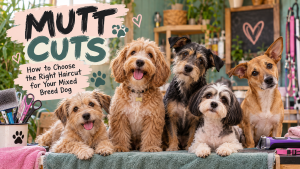
New to mixed breed haircuts? Read Mutt Cuts: How to Choose the Right Haircut for Your Mixed Breed Dog.
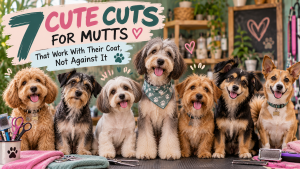
Want haircut inspiration? See 7 Cute Cuts for Mutts That Work With Their Coat, Not Against It.
Not sure this is actually a curly coat? Use the Coat Finder.
Need more help with this texture? Browse Curly & Fleece Coats.
Dealing with mats? Head to our Matting guides.