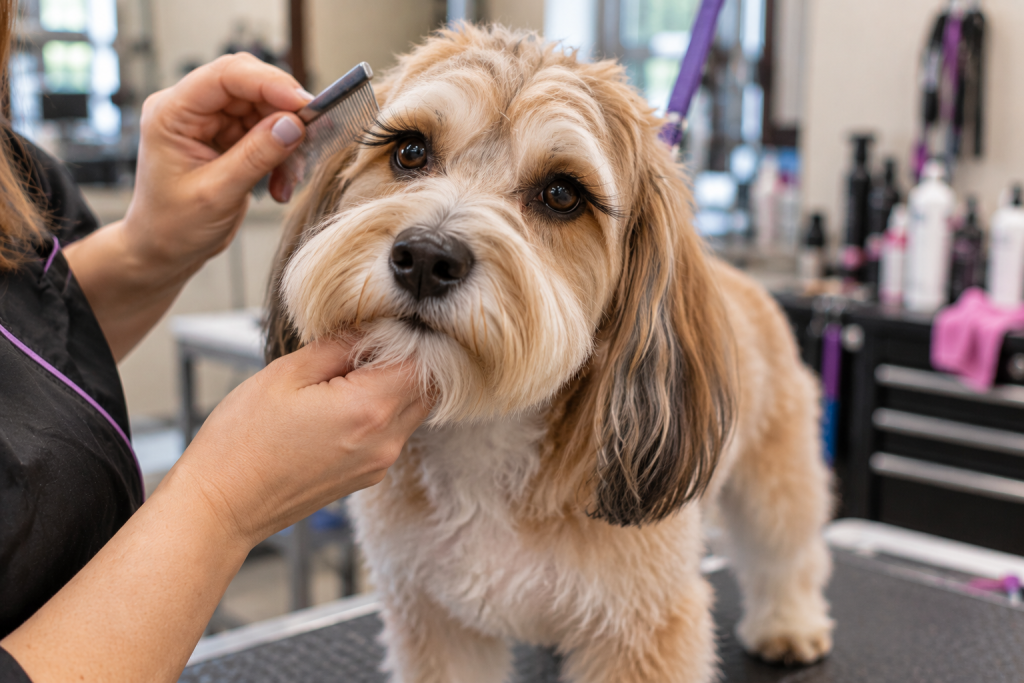
You pick up your dog from the groomer, take one look at that freshly trimmed face and immediately notice it.
The eyelashes.
Where are the eyelashes?
Or maybe it’s the beard. The eyebrows. Those ridiculous little tufts on the legs that made your dog look like he was wearing fuzzy pants.
These details have a name. Groomers generally call them furnishings, and they can make a huge difference in how a dog looks before and after a groom.
They can also make a huge difference in how much maintenance your dog needs at home.
Before you tell your groomer to “just clean him up,” it helps to know which features you actually want cleaned up and which ones you absolutely do not want touched.
What Are Dog Furnishings?
In grooming and breed terminology, furnishings generally refer to longer or more distinctive hair on certain parts of a dog’s body.
Depending on the breed and coat, that can include:
- Beards
- Mustaches
- Eyebrows
- Longer facial hair
- Leg furnishings
- Hair on the chest or underside
- Longer hair around the feet
Think of furnishings as some of the details that give a dog its recognizable silhouette.
A Schnauzer without much of a beard looks very different from one with a full beard and defined eyebrows. The same is true for many terriers and other furnished breeds.
Mixed breed dogs can have furnishings too. Your mystery mutt does not need a pedigree to grow an impressive set of eyebrows.
What About Dog Eyelashes?
What About Dog Eyelashes?
Eyelashes deserve their own conversation because owners LOVE them.
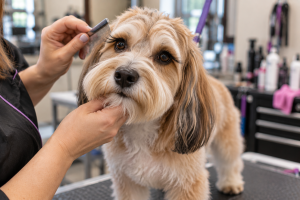
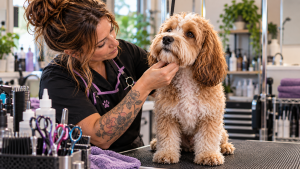
Some dogs grow remarkably long eyelashes, and they can become one of the most recognizable parts of the dog’s face. If you love them, tell your groomer you would like them preserved when it is safe and practical to do so.
Long eyelashes should not be kept purely for appearance if they are contributing to irritation, trapping debris, becoming tangled or matted into surrounding facial hair, or interfering with the groomer’s ability to safely work around the eye. Hair around the eyes also needs to be trimmed with extreme care because the dog may blink, turn, jerk or suddenly move its head.
The eyelashes themselves are not automatically a problem simply because they are long. The concern is what is happening around the eye and whether they can be safely preserved during that particular groom.
If the lashes are healthy, separate from tangled surrounding coat and not causing an obvious problem, a groomer may be able to work around them. But sometimes coat condition, eye discharge, matting, the haircut requested or the dog’s behavior makes preserving every lash unrealistic or unsafe.
And if your dog has redness, swelling, persistent tearing, squinting, discharge or appears uncomfortable around the eyes, that moves beyond a haircut preference. An eye problem should be evaluated by a veterinarian.
At check in, try saying:
“I love her long eyelashes. Please keep them if you can safely work around them.”
That tells your groomer exactly what matters to you without asking them to compromise safety to preserve a cosmetic feature.
And never attempt to trim hair immediately around a dog’s eye with household scissors because your dog suddenly decided to grow one spectacular eyebrow into its line of sight. This is one area where a surprise head movement can turn a home haircut into an emergency.
Brows Can Completely Change a Dog’s Expression
Eyebrows are another tiny grooming detail with a surprisingly big effect.
Leave them longer and a dog might look distinguished, mischievous or permanently concerned about the mortgage.
Take them shorter and suddenly the entire face looks more open.
For breeds traditionally groomed with defined eyebrows, those brows can also be an important part of the overall style.
But you are not required to maintain a traditional breed trim just because your dog happens to be that breed.
If you love the dramatic brows, keep them.
If you would rather see your dog’s eyes and spend less time combing facial hair, ask for them shorter.
The useful question is not:
“What am I supposed to do?”
It is:
“What can I realistically maintain?”
The Beard Is Cute Until Dinner
Dog beards are fantastic.
They are also collectors.
Water.
Food.
Dirt.
Leaves.
Whatever mysterious substance your dog found behind the shed.
Long beards require regular combing and cleaning because damp, dirty hair can tangle and mat.
If you love the beard but hate the maintenance, you do not necessarily have to choose between full mountain man and completely shaved.
Ask your groomer about shortening or shaping it.
You can say:
“I want him to still have a beard, but can we make it easier to keep clean?”
That gives your groomer much more useful information than simply asking for a shorter face.
Leg Furnishings Need Maintenance Too
Those beautiful longer hairs on the legs can create a dramatic finished groom.
They can also collect half the backyard.
Dogs with longer leg furnishings may need more frequent brushing and combing, especially around friction areas and places that stay damp.
This is another place where lifestyle matters.
A dog that spends most of the day lounging indoors has different grooming demands than a dog charging through wet grass, hiking trails and mud.
If maintaining long furnishings is becoming a constant battle, talk to your groomer about shortening them while keeping some shape.
Practical does not have to mean naked.
Mats Get the Final Vote
This is the part nobody enjoys.
You may desperately want to keep the beard, eyebrows, fluffy legs or other furnishings, but severely tangled or matted coat can limit what a groomer can safely preserve.
A photograph cannot change the condition of the coat sitting on the grooming table.
If an area cannot be comfortably and safely brushed or combed out, it may need to be shortened.
That is why maintenance between appointments matters so much when there are specific features you want to keep.
If you love it, comb it.
And not just the surface.
Keeping the fluff? A good metal comb is one of the simplest tools for finding tangles hiding underneath fluffy furnishings before they turn into mats. Shop our recommended grooming comb on Amazon.
Bring Photos, But Bring the Right Photos
Reference photos can be extremely helpful.
The trick is showing your groomer what you like about the photo.
Instead of handing over a picture and saying, “I want this,” point out the individual features.
For example:
“I like how round this muzzle looks.”
“I want her eyelashes left like this.”
“I like these shorter eyebrows.”
“Can we keep his beard but take some length off?”
“I want the legs fluffy like this if his coat is in good enough condition.”
That gives the groomer actual information to work with.
Your dog may have a different coat texture, head shape, growth pattern or amount of hair than the dog in the picture. The goal is not necessarily to duplicate another dog.
The photo helps communicate the features you like.
Tell Your Groomer This
You do not need to learn professional grooming terminology before an appointment.
Plain English works beautifully.
Try saying:
“Please don’t cut the eyelashes.”
“I want to be able to see her eyes.”
“Keep the beard, but shorten it.”
“I like the eyebrows longer.”
“Can you shorten the leg hair so it’s easier for me to brush?”
“I want the face rounder, not super short.”
“If something is matted and you can’t safely save it, let me know.”
Those are useful instructions.
“Make him cute” is considerably more open to interpretation.
Your groomer’s version of cute might be a neat little round face.
Your version might be a tiny woodland wizard with six inches of beard.
Both are valid.
They are not the same haircut.
Before the Groomer Starts, Look at Your Dog
Before handing over the leash, take ten seconds and identify the features you actually love.
Is it the ridiculously long eyelashes?
The beard?
The shaggy brows?
The fluffy legs?
The little mustache?
Tell your groomer.
Grooming consultations work much better when you’re describing the dog standing in front of you rather than trying to remember grooming vocabulary you saw online.
And if there is one feature you absolutely do not want changed, say it clearly before the haircut starts.
Hair grows back.
But nobody wants to spend six weeks staring at their dog whispering:
“They took your eyebrows.”
Keep Going
Not sure what coat your dog has? Start with the Coat Finder.
Curly or wavy? See our Curly & Fleece Coat guides.
Born scruffy? Head to Wire & Rough Coats.
Fluffy and shedding everywhere? Read our Double Coat guides.
Ready to learn the actual haircut process? Browse all Mutt Cut Tutorials.