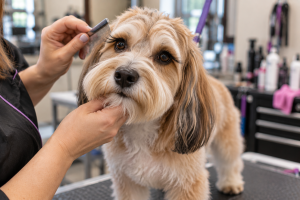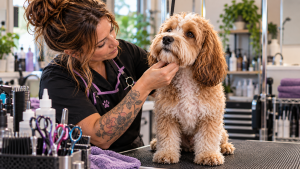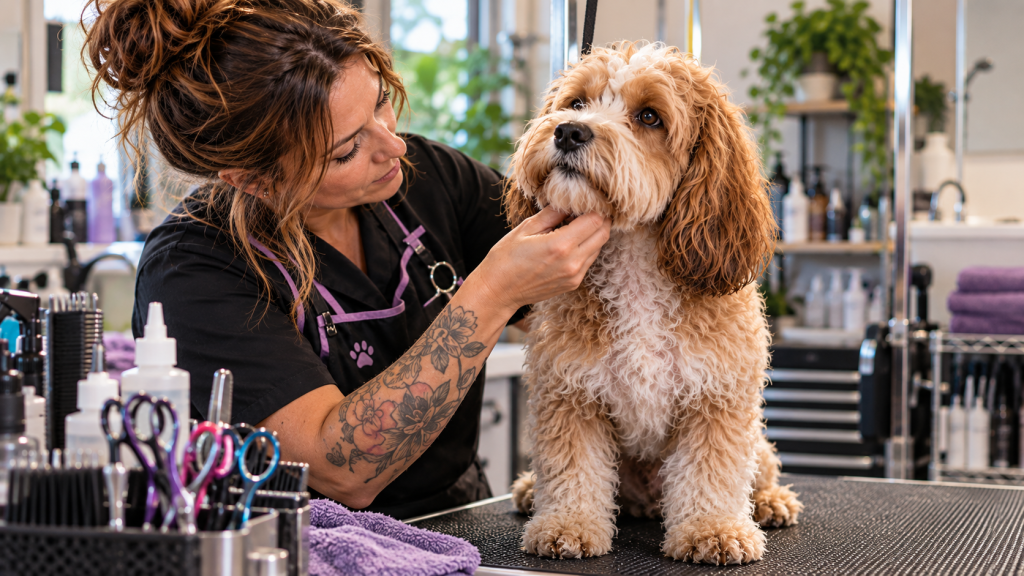
A lot happens before the clippers come on.
Before the bath. Before the dryer. Before anybody starts debating whether the owner really meant “just a trim” when they said “take him short, but not too short.”
An experienced groomer is already grooming the dog the minute they get a good look at them.
Not physically. Mentally.
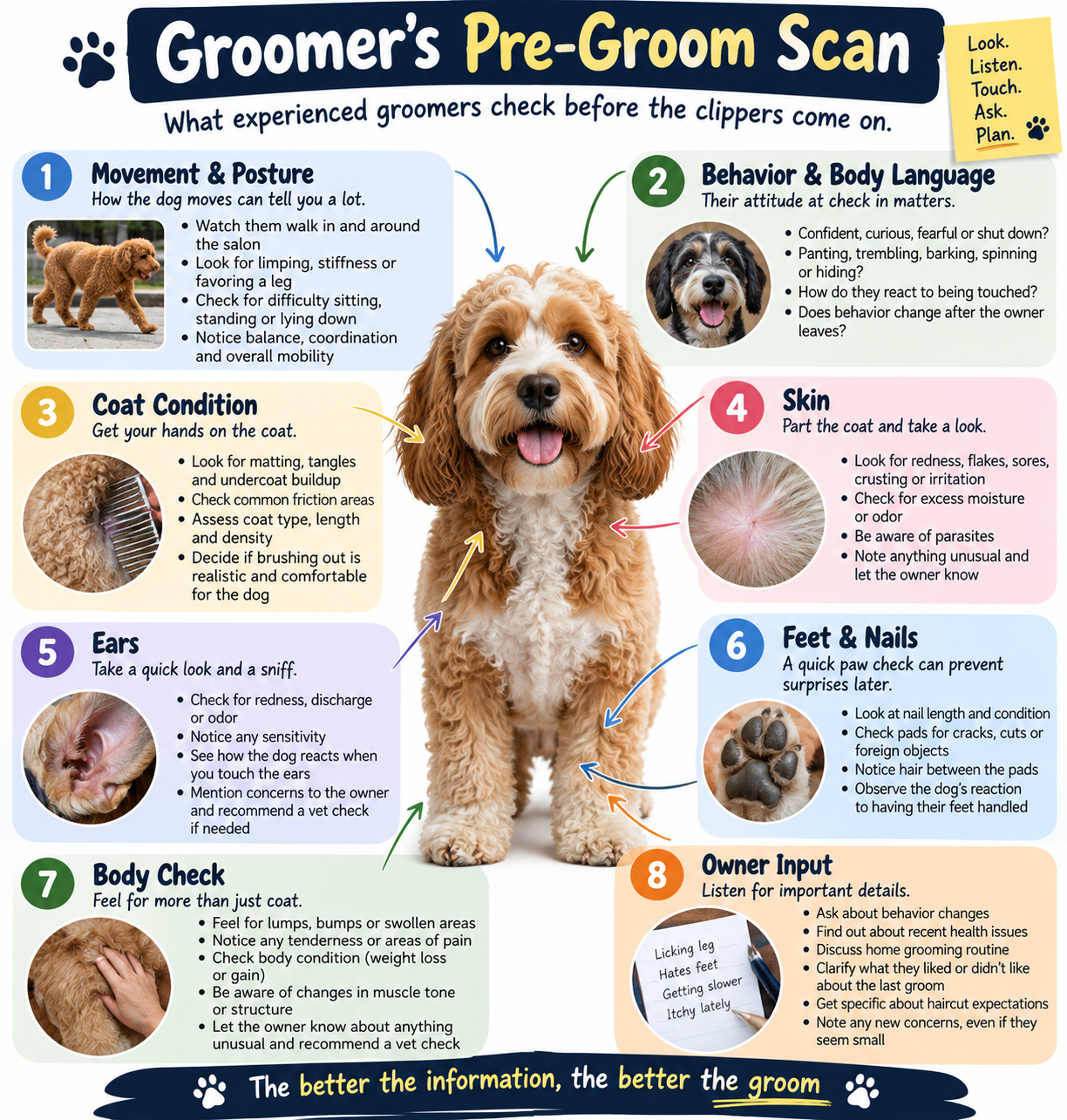
You’re looking at the coat. Watching the dog walk. Running your hands over the body. Checking what’s happening behind the ears and under the legs. You’re noticing how the dog reacts when you touch a foot.
And you’re listening to the owner.
Especially when they casually mention something important while handing over the leash.
“He’s been licking this leg lately.”
“She hates having her feet touched.”
“He’s getting a little wobbly now.”
“He has one tiny mat behind his ear.”
That last one deserves its own category of optimism.
The first few minutes tell you a lot about how the next few hours are going to go.
Start With the Dog, Not the Haircut
Owners naturally think about the finished groom.
Groomers have to think about the dog standing in front of them.
Before deciding exactly how to approach the haircut, look at the whole dog.
How are they standing?
Are they putting equal weight on all four legs?
Are they stiff through the hips?
Are they panting before anything has even happened?
Are they pulling toward the door, happily investigating the shop, hiding behind their owner, trembling, barking, spinning or completely checked out?
None of these things automatically mean you can or cannot groom the dog.
They’re information.
A senior dog with weak hips may need a completely different grooming setup from the same dog five years earlier. A nervous puppy may need more time and fewer expectations. A dog that suddenly objects to having one particular leg handled may be telling you something besides, “I don’t like nail trims.”
Experienced groomers learn not to bulldoze past those little clues.
Your Hands Tell You More Than Your Eyes
A coat can look pretty decent from six feet away.
Then you put your hands on it.
That’s when you find the compacted undercoat. The matting close to the skin. The tiny knots hiding behind the ears. The friction mats in the armpits. The mess under the collar or harness.
You may also feel things that have absolutely nothing to do with the haircut.
A lump.
A scab.
A skin irritation.
A tender spot.
A change in body condition.
Something stuck in the coat.
That doesn’t make a groomer a veterinarian, and it shouldn’t turn into an amateur diagnosis.
It means you noticed something.
Tell the owner what you found and where you found it. If it looks concerning, encourage them to have their veterinarian take a look.
Knowing the boundary between observing and diagnosing matters.
Check the Places Owners Usually Miss
If somebody tells you they brush their dog every day, that may be completely true.
The question is where they brush.
The back usually looks fantastic.
Meanwhile, behind the ears is building its own civilization.
Check the friction zones.
Behind the ears.
Under the collar.
Armpits.
Chest.
Belly.
Inside the legs.
Tail.
Rear end.
Anywhere a harness regularly rubs.
These areas can tell you much more about the actual condition of the coat than a quick pass of the brush across the dog’s back.
This is also where coat assessment matters.
Can the coat realistically be brushed and combed out without putting the dog through an unreasonable amount of pulling and discomfort?
If not, the haircut plan may need to change.
That conversation is much easier to have before the groom than after it.
Groomer’s Tool Pick
A fluffy coat can look fine on top and still hide tangles underneath. A simple metal grooming comb helps you check whether you’re actually getting through the coat to the skin. → Check the Andis Grooming Comb
Look at the Skin Before You Cover It in Shampoo
Parting the coat in several places takes seconds.
Do it.
Look for redness, flakes, sores, moisture, crusting, irritation, parasites or anything else that seems unusual.
Pay attention to odor too.
Groomers become very familiar with what a normal dirty dog smells like.
Something noticeably different is worth noting.
Again, you don’t have to decide what caused it.
You just need to know it was there before you started.
That protects the dog, helps the owner and gives you a baseline if something becomes more noticeable during the groom.
Feet Can Tell You What Kind of Day You’re About to Have
Touch a foot.
Sometimes that is all the preview you need.
Look at the nails, pads and hair between them, but watch the dog’s reaction too.
Does the dog calmly let you hold the paw?
Immediately jerk it away?
Mouth your hand?
Panic?
Try to climb over your shoulder?
Foot sensitivity can affect much more than the nail trim.
It can change positioning, clipping, scissoring and how much handling the dog will comfortably tolerate.
Also check whether nails are extremely long, curling, broken or otherwise unusual.
You don’t want to discover a problem halfway through the groom that you could have spotted at check in.
Ears Deserve a Look Before the Bath
Lift them.
Look.
Smell.
You aren’t diagnosing an ear infection.
You’re checking what condition the ears are in before you start handling and bathing the dog.
Redness, discharge, strong odor, obvious sensitivity or a dog suddenly fighting you when an ear is touched are things worth documenting and mentioning to the owner.
If something doesn’t look right, don’t pretend you didn’t see it because there’s a grooming schedule to keep.
The Previous Haircut Leaves Clues
Sometimes another groomer has already left you a little roadmap.
Look at how the coat is growing back.
You may see clipper lines, uneven growth, previously shaved areas, coat damage or places where somebody apparently made a decision and immediately regretted it.
You can also get clues about what the owner considers “short.”
This becomes especially useful with a new client.
Instead of relying entirely on:
“About half of what he has now.”
You have physical evidence sitting directly in front of you.
Ask questions.
“When was his last groom?”
“Was this about the length you liked?”
“Did you like his face last time?”
“Do you want to see his eyes?”
“How much maintenance are you doing at home?”
Specific questions get much better answers than asking, “What are we doing today?”
Listen for Changes
One of the most useful things an owner can tell you is that something is different.
“He never used to hate his back feet.”
“She suddenly doesn’t like being picked up.”
“He’s been scratching a lot.”
“He’s having trouble standing very long.”
“He’s been acting weird when we touch his ear.”
Those comments matter.
A behavior change can affect the groom even when nobody knows yet why the behavior changed.
Write it down.
Adjust where appropriate.
And if something seems outside the normal scope of grooming, say so.
Watch the Dog After the Owner Leaves
This part can be interesting.
Some dogs who looked absolutely devastated thirty seconds ago suddenly straighten up and walk into the salon like they’re reporting for their shift.
Others become more nervous.
Some settle.
Some start looking for an escape route.
The owner’s presence can change behavior in either direction.
What matters is the dog you’re actually working with.
Keep reassessing.
The dog you checked in isn’t necessarily the dog you’ll have on the table an hour later.
Build the Groom Around the Dog You Actually Have
This may be the biggest difference experience makes.
You stop trying to force every dog through the exact same process.
The puppy doesn’t need to achieve grooming perfection on visit number one.
The arthritic senior doesn’t need to stand like a statue because that’s convenient for us.
The terrified dog doesn’t become easier because we’re in a hurry.
And the severely matted dog doesn’t magically become brushable because the owner wants an inch of coat left.
The haircut matters.
But the condition, comfort and behavior of the dog determine how you safely get there.
Sometimes the plan you had at check in will change.
That’s not necessarily a failed groom.
Sometimes that’s good grooming.
The Clippers Aren’t the Beginning
By the time an experienced groomer turns on the clippers, they’ve already made dozens of small assessments.
They’ve looked.
Touched.
Listened.
Asked questions.
Noticed what was normal and what wasn’t.
They’ve started figuring out what this particular dog can comfortably handle today.
That’s the part of grooming clients rarely see.
The finished haircut gets photographed.
The bow gets noticed.
The clean feet and round face get compliments.
But a lot of the actual skill happened before any of it.
Sometimes the most important thing a groomer does is notice something before they ever make the first cut.
More Resources
Coat & Skin — coat types, matting, shedding, skin observations and coat maintenance
Tools & Equipment — clippers, blades, shears, dryers, tables and what is actually worth buying
Safety First — pre groom checks, injuries, sanitation, equipment safety and knowing when to stop